Related Blogs
Modern hair care has moved way beyond the old model of “oil + shampoo.” Now, systems are designed for very specific functions: cleansing, moisturising, repairing, shielding. Here, we have two complementary methods that arise: leave-on systems (products you don’t rinse out of your hair after application) and rinse-off systems (products you rinse out fairly quickly). Knowing how both of these work, and when to use them, can help you have stronger, healthier, more manageable hair.
In this article, we shall define “hair-care systems,” discuss what rinse-off and leave-on are, explore the scientific difference between the two, discuss choice by hair type, show how they work together, and point out limitations and caveats.
What Are Hair Care Systems?
A “hair care system” refers to a formulation (or a set of formulations) created with a specific purpose. For instance, cleansing the hair and scalp, repairing structural damage to hair fibres, or protecting hair from external stressors (heat, UV, pollution). These systems are often classified not just by purpose but by how they’re applied, how long they stay on the hair, and how deeply they interact.
Two broad classes based on application time and interaction level:
- Rinse-Off Systems: These are products applied, left on for a short span (minutes), then rinsed out. Their interaction is relatively superficial (on the surface of the hair or just within the outer layers).
- Leave-On Systems: These are applied and left in (until the next wash, or over many hours). They are designed for extended contact and more sustained effect.
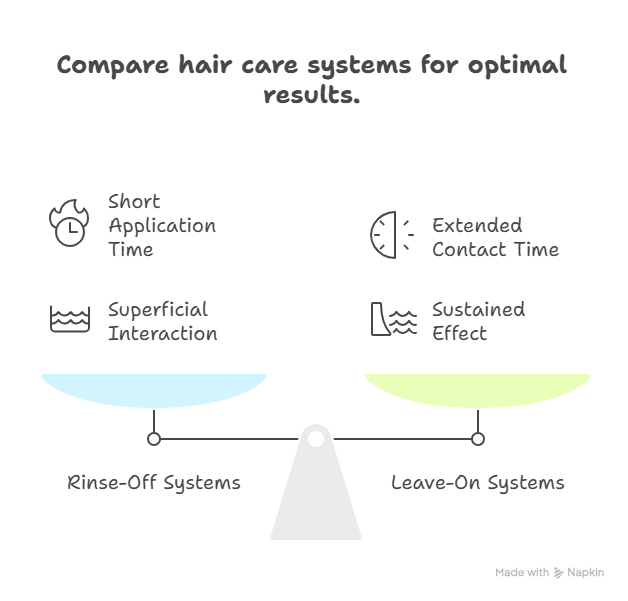
Fig 1. Classes of Hair Care Systems
What is a Rinse-Off system?
Rinse-off products are designed to work during a short contact time and then be washed away. They include shampoos, conditioners, rinse-out masks, and clarifying treatments.
Functions
- Cleanse away sebum, sweat, product residue, and pollutants (shampoos).
- Detangle and smooth the cuticle to reduce friction (conditioners, masks).
- Provide quick surface repair and restore moisture balance.
Common Ingredients
- Surfactants (e.g., SLES, coco-betaine) remove oil and dirt.
- Emulsifiers keep oil-and-water formulas uniform.
- Mild conditioning agents (cationic polymers, fatty alcohols) add slip.
- Proteins/peptides (hydrolysed keratin, wheat) temporarily fortify the cuticle.
Benefits
- Fast action, clean feel, minimal residue, ideal for daily or frequent use.
- Offer customisation options, from gentle everyday shampoos to deeper clarifying washes, and from light conditioners to rich, intensive formulas.
Limitations
- Effects are mostly temporary because products are rinsed off.
- Deeper repair or lasting frizz control typically needs complementary leave-on care.
What is a Leave-On system?
Leave-on products stay on the hair after washing and are not rinsed. Examples include serums, sprays, creams, leave-in conditioners, and heat protectants.
Functions
- Deliver ongoing protection, moisture retention, smoothness, UV and heat defence.
- Improve manageability, reduce frizz, and enhance shine between washes.
Common Ingredients
- Silicones (dimethicone, amodimethicone) for slip, gloss, and heat protection.
- Natural oils/butters (argan, coconut, shea) to soften and seal moisture.
- Film-formers (polyvinylpyrrolidone/vinyl acetate, acrylates) to control frizz and hold style.
- Vitamins/antioxidants (panthenol, vitamin E) and UV filters for protection.
- Humectants (glycerin) and proteins/ceramides for strength and hydration.
Benefits
- Continuous action between washes, noticeable frizz control, better shine and softness.
- Targeted performance (e.g., curl creams for definition, serums for sleekness).
Limitations
- Overuse or heavy formulas can cause buildup or weigh hair down.
- Choose dose and texture by hair type (fine hair = lighter sprays/milks).
- Clarify periodically if styling layers accumulate; apply mid-lengths to ends.
Scientific Difference: Contact Time and Delivery Mechanism
Let’s understand how and why rinse-off vs leave-on differ on a mechanistic level. This helps explain why they’re complementary rather than interchangeable.
Feature | Rinse-off System | Leave-on System |
Contact Time | Short (seconds to minutes); removed after use | Long (hours to days); remains until next wash |
Delivery Approach | Quick adsorption of actives on the hair surface; most excess is rinsed away | Slow, sustained release; actives remain adhered for continuous effect |
Key Mechanism | Surfactants, water-soluble conditioners, deposit a thin layer and then wash off | Film-formers (polymers, silicones, oils) build a persistent protective layer |
Barrier Function | Minimal; primarily cleansing and instant detangling | Strong; reduces transepidermal water loss (TEWL), protects from heat/mechanical damage |
Molecular Design | Smaller, hydrophilic or amphiphilic molecules for quick action and easy rinsing | Larger, more hydrophobic molecules designed for adhesion and longevity |
Residue Retention | Low; limited residue remains after rinse | High; significant retention of actives on hair surface (as shown in JDD Online studies) |
Functional Outcome | Immediate results (clean scalp, smooth feel), but effects fade quickly | Longer-lasting benefits (moisture lock, frizz control, UV/heat protection) |
Example Formulations | Shampoos, rinse-out conditioners, quick masks | Serums, leave-in conditioners, protective sprays, and tonics |
Use Case | Routine cleansing, surface repair, prep step before deeper care | Sustained conditioning, damage prevention, and ongoing protection between washes |
Choosing The Right System For Your Hair Type
Finding the right balance between rinse-off and leave-on care depends largely on your hair’s needs and texture. Each hair type benefits from different approaches to moisture, weight, and protection.
Leave on systems work the best for hair that feels rough, brittle, or prone to breakage. Leave-in conditioners, serums, and oils lock the moisture in after washing and deliver strengthening ingredients over time. Always look for formulas rich in proteins, ceramides, or natural oils to rebuild resilience and prevent further damage.
Lightweight rinse-off systems are ideal here. Clarifying shampoos can gently remove excess sebum without over-drying, while lightweight conditioners rinse cleanly without weighing strands down. Leave-on products can still be used sparingly. Prefer sprays or water-based formulas applied to mid-lengths and ends.
Colour-Treated or Chemically Processed Hair
A combination approach works best. Start with a sulfate-free, gentle rinse-off shampoo and conditioner to cleanse without stripping colour. Follow with a protective leave-on product containing UV filters, antioxidants, or heat protectants to shield hair from fading, dryness, and external damage.
This hair type thrives on moisture and definition, making leave-on systems essential. Hydrating creams, curl enhancers, and oils help reduce frizz, lock in hydration, and define curl patterns. Co-washing or using moisturising rinse-off cleansers can also prevent dryness.
Minimalist or Low-Maintenance Routines
If simplicity is your goal, prioritise a balanced rinse-off routine with a gentle shampoo and conditioner tailored to your hair type. Then, choose one multitasking leave-on product, like a lightweight serum or leave-in conditioner, to provide protection and shine without extra steps.

Fig 2. Hair Care Systems For Different Hair Types
Using Leave-On and Rinse-Off systems together
The real strength of hair care lies not in choosing one system over the other, but in how they work together. Layered thoughtfully, rinse-off and leave-on products complement each other to deliver deeper, longer-lasting results.
Rinse-Off First
The process begins with cleansing the scalp and strands using shampoo, followed by a conditioner or mask to detangle, smooth, and restore surface moisture. At this point, the hair fibre is cleaner, cuticles are more aligned, and the surface is optimally prepped to absorb what follows.
Leave-on Second
Once the hair is towel-dried or partially air-dried (as directed by the product), a leave-on product is applied. This step seals in moisture, forms a protective layer, and enhances smoothness and shine. It shields the hair from external stressors such as heat, UV exposure, and pollution.
Practical Tips For Balance
- Avoid “product overload.” Layering too many products (especially leave-on heavy creams + oils + sprays) can weigh hair down, cause buildup, or limit scalp breathability.
- Repeated use of heavy silicones or oils in both steps may create residue and diminish results.
- A clarifying rinse-off treatment once a week or bi-weekly refreshes the scalp and removes accumulated product layers.
- With leave-ons, small amounts used consistently are often more effective than heavy application.
- If the scalp is prone to oiliness or irritation, choose leave-on products designed to avoid scalp buildup.
Conclusion
Rinse-off and leave-on systems are distinct yet complementary. Rinse-off systems cleanse, reset, and prepare. On the other hand, leave-on systems protect, nourish, and sustain. A clear understanding of how they differ in terms of contact time, mechanism, delivery, benefits, and limitations gives you better control of your routine. The real secret lies not in choosing “either/or” but designing a balanced routine that cleanses, nourishes, protects, and adapts to your hair type and condition.
Apply rinse-off products to remove build-up and condition the hair. Then, with layering leave-on products for ongoing protection and improvement, you stand a much better chance of achieving hair that’s not just manageable today but resilient tomorrow!
About NICHEM
Long-standing Specialty Chemicals player with ISO 9001:2015 certification and a history of providing specialty solutions for over 25 years. The company is headed by senior chemical industry specialists with the combined expertise of more than 100 years. With an emphasis on eco-friendly, non-toxic products, the company’s primary strength is research, development, and customisation. More information on NICHEM can be found at https://nichem.solutions.